For more information about Royal Holloway, please see this promotional video. To see a promotional video for the MA Consumption, Markets & Culture see here. To see a promotional video for the Royal Holloway School of Management, click here.

For more information about the Royal Holloway MA Marketing and MA Consumption, Culture & Marketing and the application process see here.

To get an understanding of the unique values that underly the MA Marketing and MA Consumption, Culture & Marketing programme please read these blog posts: Value of Scholarly Values, Importance of Reading and Morris Holbrook and Business Interest in Education.

Wednesday, 9 March 2016

Hector Murphy writes about his dissertation


 Width of marketing and selecting a subject – your own interest

Marketing, as an academic discipline, constitutes an extremely broad field with marketing literature making use of concepts, theories and techniques from sociology, business studies, psychology, and numerous others. While at first this breadth can present quite a daunting range of possibilities when trying to pin down a topic for a research-based dissertation, the most important thing to do is to select a topic that you have a definite interest in. This might sound obvious but choosing to research something that you actually want to know more about, rather than something that you think would be easy to study and produce a 12,000 word thesis on, will not only help to keep you motivated throughout the process but will also help you to produce genuinely original and interesting research.


            Having entered university in the UK at a time of significant change, both for the form of higher education institutions and the sector within which they reside, I was particularly interested in examining the nature of these changes and how they have come about. During my time at Royal Holloway, I took part in a number of student demonstrations against issues connected to these changes, such as higher tuition fees and the profit-motivated closures of small but invaluable academic departments. As much as marketing might seem a strange choice of discipline from which to launch an interrogation and critique of marketisation, it became ever more clear to me that the huge mixture of ideas and research instruments available made it the perfect choice.
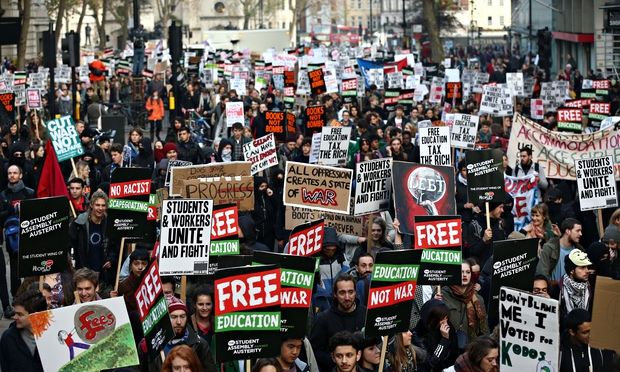

           
            The primary constraints on any research dissertation are the maximum allowed length, and the resources available to you as an MA student. These constraints were actually of great use to me in terms of setting achievable goals for my research. I wanted to better understand the more subtle forces that serve to create an environment in which higher education institutions come to be thought of as businesses in a competitive market and begin to behave as such. Part of this interest was also inspired by Chris Hackley's Critical Marketing course, to which I have to give a good deal of credit. 

           In doing preliminary research I came to see that there are a multitude of social, cultural and economic forces and that to try to produce comprehensive own research would leave me no room to actually look at anything in depth. At this point the importance of working together with my supervisor was made manifestly clear to me. Alan advised me to try to look into an element that I had a more personal experience of, and to do so to the greatest possible depth. Choosing a micro-, rather than macroscopic focus might seem like it would hinder your ability to answer whatever grand questions you might have about your topic, but this was something important I had to realise about academic research; it is far better to say something new about a small area, and in doing so actually contribute to scholarly discourse on it, than to simply retread the same ground that has already been covered by masses of books and research literature.
           
            Having waded through numerous university league tables and rankings on the way to choosing Royal Holloway to study at, and subsequently finding that these had almost nothing to do with what I experienced as a Royal Holloway student, these seemed a clear choice. Smartphones as consumer goods can be benchmarked against each-other on a basis of technical specification, as can cars, and computers for instance, but is it useful to try to fit university education in to this commodity market paradigm? Furthermore, as this is already happening, how are the effects of this experienced within universities? These were, I believed, questions that I could really sink my teeth into, and with Alan's suggestion that I look into literature making use of Michel Foucault's concept of governmentality (the way in which subjects are bought to behave and regulate themselves according to a given ideology without direct command or coercion) I set to work.

Michel Foucault


            The unit I had taken on qualitative research methodologies had given me the skills and confidence to make use of a mixed-methods approach combining critical discourse analysis with qualitative interviews. This allowed me not only to examine what elements of higher educational institutions were valued in rankings and league tables, but also to understand how the privileging of certain abstract elements of higher education changed the way in which academics and institutions had to behave. Through a sustained campaign of emailing the heads of departments at a large number of universities I (admittedly to my surprise) found a number who were willing to take part in semi-structured interviews about my topic. I combined this with a close analysis of the websites and presentational styles of a number of leading league tables and ranking exercises, which were also discussed with my interviewees.
           
            This combination produced a number of interesting conclusions and while it was of course gratifying when my conclusions matched closely with my original presuppositions, I found it most exciting when I became aware of points I had not considered before and additional nuance that could serve as a starting point for even further research. Although I had originally suspected that all league tables and rankings had some effect, it became clear that those carried out by the government itself, such as the Research Excellence Framework were clearly the most significant to those I had interviewed. The fact that these exercises in particular are tied to future research funding as well as job prospects meant that they exert significant power over the activities of institutions and academics; what is important to the REF inevitably becomes important to universities because to ignore it means that an institution has no hope of meeting the abstract criteria of 'excellence', however valuable and novel its research might be by other standards. At the same time, while commercial league tables are less significant to research funding, they are of great importance in attracting paying students, and so again I found that they directly feed in to a discourse of students as consumers and higher education as a commodity.

            Although I found that both league tables and government-run ranking exercises contributed to a marketised view of higher education, they do so in different ways, with league tables focusing on education itself as a commodity, and ranking exercises focusing on the research that universities produce as a commodity. Returning to what I mentioned earlier about taking a deep focus on a small area, I found that my dissertation had indeed answered some of my early questions about marketising effects in higher education, but had also opened up a few pathways for future research in the area. I fully believe that without the breadth of knowledge and techniques made available to me on the marketing course, it would have been extremely difficult to produce a dissertation on this subject to the same level.


Tuesday, 9 February 2016

Learning Adventures in a Pub Servicescape: Are you pulling my pint ?

Are you really pulling my pint ?


Services Marketing students from Royal Holloway were taken by surprise on Monday when halfway through their workshop they were invited to pack up their stuff and head out into the big, wide world.  


With a significant storm passing through the idea of intrepid adventurers is perhaps only modest puffery.   Having engaged in MBA Director Justin O'Brien's flipped classroom lecture, that had considered service quality and the service environment (or Bitner dubbed 'Servicescape'), students were invited to put their learning directly into action with a nearly spontaneous field visit to the university staff's little known drinking hole, The Happy Man.    


This innovative servicescape seminar experience took place on Chinese New Year, so the MA Marketing students were not really being cheeky monkeys by engaging fully in a  multi-sensory experience that took in all five senses of the ambience.  One of the locals, bemused by the swarm of mid-afternoon customers, was overhead lamenting "I wish my university lectures had been like this."


Working in small groups the highly motivated masters students were challenged to put learning from the preceding lecture directly into action, seeking out examples of  signs, symbols and artefacts, assessing the service layout and evaluating the ambience,  from inside the warm and cosy pub (it was blowing a gale outside thanks to Imogen).  


Most students were unaware of the Happy Man, it is rather tucked away, but literally just around the corner from the students favourite 'Monkey's Forehead', which is also managed by landlord Dave Lacey. Both pubs are located just a few steps beyond Royal Holloway's imposing Victorian campus walls, but the mostly international student group were quite unfamiliar with the myriad of rituals that accompany English pub consumption.


Students toured the modestly sized, traditional pub searching out signs, symbols and artefacts. From pump ring logos to branded Guinness drip maps, Kozel beer signs and the last orders bell (see above photo) this authentic cottage bar offered much more than initial impressions might have suggested.  What does it mean, some pondered, to have charity collection containers nestled amongst the pumps ?     


Justin's favourite element of the Happy Man servicescape is the beer label murals, carefully and consistently fixed on top of the flocked wall paper to create a visual history of the many and varied guest beers consumed by regular customers.  Whilst perhaps a little quirky and unusual, each cask of new, guest beer is promoted using these modestly produced plastic laminated signs.  


Pragmatically even sometimes just a hand written sign on any old spare piece of white paper (see example above, centre photo).  To the cognoscenti the wall decor, which covers most of the vertical surfaces in each of the four separate rooms, provides a clear symbol of a "proper beer" pub, championing the CAMRA inspired grass roots craft beer movement, which seeks to celebrate small scale, local beer production by encouraging consumers to vote with their spending power and bar stool banter.


The Happy Man is popular with local residents and regularly hosts beer festivals, where a wide range of different craft beer, often sourced from all over the country, is available to taste. The staff's favourite pub secret is now out, will Justin ever be forgiven ?

Friday, 29 January 2016

Research Seminar - Employability


Location
Moore Building 008 (MBS008)
Date(s)
03/02/2016 (13:00-15:00)
Title: `The Concept of Employability'
Theme Group: Working Life
Speaker: Dr Alan Bradshaw, School of Management.
Dr Alan Bradshaw will give a short presentation designed to introduce some of the critical issues from the literature, after which the topic will be opened up for discussion. The intention is to encourage critical reflexivity on our own practices and generate discussion, rather than to receive new research findings as such. As this is a topic that affects us all in terms of the increasing requirements to develop the capacity of our students to function effectively in the job market, we hope this will be a seminar that many of you will be interested in participating in. 
To remind you, the intention is for the Working Life theme to explore issues of interest and relevance across the School of Management, bringing together our own staff and PhD students as well as external experts. The broad remit of the theme is stated here:
https://www.royalholloway.ac.uk/management/research/themegroups/working-life.aspx
For catering purposes, please contact Professor Chris Rees to confirm your attendance; or if you have any queries, comments or suggestions.
All welcome. Lunch is available at 13:00.

Promotional Video for MA Consumption, Culture & Marketing

See the promotional video for MA Consumption, Culture & Marketing here.

Monday, 18 January 2016

MA Marketing students at Harlequins v Cardiff

On Sunday, students from the MA Marketing were able to brave the cold and attend the Harlequins v Cardiff rugby game on Sunday at the Stoop as part of their studies in the Services Marketing Course. 


Friday, 15 January 2016

Vicki Harman on Thinking Allowed


Vicki Harman, Programme Director of the MA Consumption, Culture & Marketing, appeared on BBC Radio 4 this week to discuss her research on lunchboxes, published in Sociology, which she wrote in collaboration with Benedetta Cappelini (who is the programme deputy director).

You can listen to Vicki discussing her research with the renowned sociologist and broadcaster Laurie Taylor here.

Friday, 27 November 2015

Dying to Consume

Dying to Consume – sustainability and dilemmas of imagined futures

Room: ABF016 (15) – Arts building first floor, room 016.
Date: Wednesday, 02 December 2015
Time: 13:00-15:00
All welcome
 
University of Southern Denmark

Contemporary consumer societies are predicated on unsustainable lifestyles. (Reich 2001: 374). However, rather than being a problem of the present, sustainability is set up as an exchange with an imagined future. The Brundtland Report for instance defines sustainable development as development that is able: “…to ensure that it meets the needs of the present without compromising the ability of future generations to meet their own needs…” (Brundtland et al. 1987: chapter 3 section 27, emphasis by the authors). Sustainability therefore requires conceptual clarity about the future. However, Connolly & Prothero note that sustainability is related to ‘how long’ consumption levels can be upheld; ‘sustainable consumption’ is therefore inherently a ‘fuzzy concept’, because “scale, scope, point of reference and the time horizon remain unclear” (2003: 276). This conceptualization opens up the need for a more rigorous theorisation of ‘time horizons’.

We suggest taking anticipated death into account as an important ‘time horizon’ and ‘point of reference’ in sustainability. Drawing on Heidegger (2010) we propose that cultural orientations toward mortality inform fundamental structures and dilemmas involved in consumer imaginations of the future. Sustainability therefore forces us to consider inherent differences vis-à-vis individual’s relationships to society in pre and post dying futures.

We show that these dilemmas of death appear as a number of culturally informed wicked problems in ‘future oriented consumption’ (Robinson 2015). The “wicked problems” are a series of dyadic alternatives, or marketing conundrums, such as those between: “consumer goods and hope” (Conolly & Prothero 2003: 286); ‘psychology’ and ‘materiality’ (ibid. 288), ‘hedonistic consumer’ vs ‘responsible consumer’ (D’Antone & Spencer 2015: 57); ‘structural conditions’ vs ‘agency’ (ibid); ‘materialism’ vs ‘spirituality ’ (Stern 1997: 16); and ‘personal well-being’ vs ‘welfare of the community’ (Seth et al. 2011: 24). More specifically we claim that Capitalism affects these dilemmas by intervening in the intersection of sustainability and anticipated future mortality, such that it serves the hegemonic interests of big business (Kilbourne & McDonagh 1997).

With a theory of the imagined future that centres on constructions of anticipated mortality, it becomes possible to mobilize insights from the anthropology of death (Green 2008; Palgie & Abramovitsch 1984) to critique the capitalist appropriation of sustainability and the problems this gives rise to when pursuing ‘sustainable consumption’ (Dolan 2001). Based on ethnographic research in the United States, Green (2008) finds that American cultural scripts emphasize heroic struggle and individual control over the timing and manner of our deaths, informed by a salvationist ethos (Sahlins 1996) that emphasizes self-enlightenment and freedom to choose over communal engagement and ethical commitment. We therefore hypothesize that in America and in Britain especially, increasingly individualized notions of “good deaths” is implicated in society-wide reluctance to seriously address issues of sustainability. This perspective suggests a need to change our ways of thinking about sustainability, and shift our focus from imagined futures to the present.