For more information about Royal Holloway, please see this promotional video. To see a promotional video for the MA Consumption, Markets & Culture see here. To see a promotional video for the Royal Holloway School of Management, click here.

For more information about the Royal Holloway MA Marketing and MA Consumption, Culture & Marketing and the application process see here.

To get an understanding of the unique values that underly the MA Marketing and MA Consumption, Culture & Marketing programme please read these blog posts: Value of Scholarly Values, Importance of Reading and Morris Holbrook and Business Interest in Education.

Tuesday, 19 November 2013

British Airways - #lookup in Piccadilly Circus


Following on from a surprising (and particularly well received) sponsorship hit at London 2012 with its Park Live concert/chill out space on the banks of the reclaimed river, British Airways marketing team have #lookedup (sic) for inspiration in their latest marketing initiative.  Since the late 1980's generations of British Airways fmcg trained marketers have trail blazed ahead of other service brands, stylishly presented different aspects of the emotions of flying. 
 
Claiming this clever use of technology as an advertising first, the ‘magic of flying’ campaign seeks to remind people how magical flying can be by the playful and fresh use of the perspective of a child.  You can perhaps imagine the advertising creative team pitching this concept.  It certainly does stand out and a powerful conceptualisation that is innovative for the British airline that has most recently be plugging its patriotic flag carrier status via the "to fly, to serve" campaign. 
 
Digital billboards located in London's Chiswick and Piccadilly interact with overhead aircraft. "The system tracks the aircraft and interrupts the digital display just as it passes over the site, revealing the image of a child pointing at the plane, accompanied by its flight number and destination it’s arriving from." (Marketing Week, 19 Nov 2013)
 
I wonder what it says when a competitor aircraft flies over ?  "Another of Richard's planes" ?

Sunday, 17 November 2013

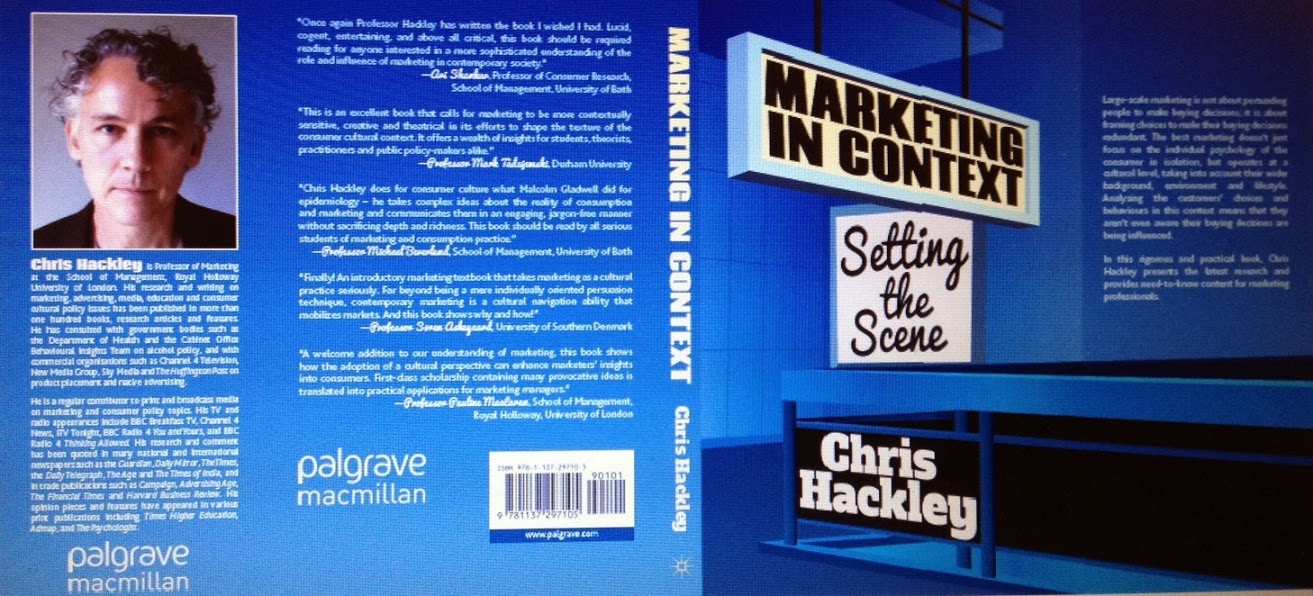
Marketing In Context


My new book, Marketing In Context, attempts to apply a consumer cultural perspective to marketing management and consumer policy issues. I discuss it in a podcast interview with Anna Farmery of www.theengagingbrand.com website here and there are cover reviews, contents and chapter excerpts on the publisher website here. It can also be purchased on Amazon here .

The book draws on many examples of recent brand marketing campaigns to try to show how the most creative and engaging marketing rests on a nuanced understanding of the cultural contexts of consumption. It uses the theatrical metaphor of the mise en scene to offer a sense of marketing not as a cognitive or neurological science of consumer control, but as method of cultural priming. The aim of the book is not to achieve a thoroughgoing cultural critique or to develop an academic theory but, rather, to sketch out a managerial account of marketing that resonates with current practice in the convergent economy.

One sub-theme of the book echoes Vance Packard's famous critique of marketing's use of depth psychology, which he published in 1957, and called The Hidden Persuaders. Packard's book was a call to arms for consumers to be alert to marketing's sinister use of shadowy social scientific techniques for manipulating consumer behaviour. In Packard's day the fear was of motivation research and 'subliminal' advertising. Today, the suspicion of marketing rests on its uses of neuropsychology ('neuro-marketing') or electronic surveillance and data-gathering.

In Marketing In Context I suggest that, in fact, Packard was tilting at the wrong windmill. Marketing's techniques of consumer control have been oversold. They don't really work. Its truly deep influence is not cognitive or behavioural but ideological, and I try to illustrate this with examples from Edward Bernays's propaganda model of Public Relations in the 1940s to the current fad for marketing that doesn't sell anything, like product placement, sponsorship, 'content' marketing and 'native' advertising.

Unlike Packard, I'm not unduly worried by marketing's subtle influence in framing my buying behaviour. Our sense of agency in consumer culture may be illusory, but there is no place beyond in which we could achieve a more authentic sense of realisation. Unlike the set in the Jim Carrey movie 'The Trueman Show', we cannot crash through the illusion of marketing to find a new world untainted by commerce. The influence of the market is thoroughly integrated into culture and our task is to try to understand how this plays out under the influence of the convergent media-driven economy. I think that the marketing discipline has been distracted by the chimera of consumer control through psychology, and its cultural influence needs to be acknowledged, for the ultimate benefit of consumers, citizens, managers, policy-makers and regulators.                        


Wednesday, 9 October 2013

2013 MA Marketing Camp - The Market, Violence & Consumers

2014 MA Marketing Camp
The Market, Violence & Consumers

7 November, 2013, 6:00 pm
Senate House, Room 264
Keynote Speaker: Heide Gerstenberger, University of Bremen

The Markets, Violence and Consumers


There is no doubt about it. Capitalism has been one of the great hopes in the development of mankind. And not only proponents of capitalism but also many of its Marxist critics have agreed that its development marks, indeed, an advancement in humanity. Contracts would – and they eventually more or less did –replace the use of direct violence in labor relations. And international trade relations, while not the civilising force which had been expected of them in the eighteenth century, are no longer most often established by force of arms. In some sense capitalism has become domesticated. It is no accident that it was in the 1970s that Johan Galtung has suggested to grasp the new forms of imperialism through the analytical concept of “structural violence”. Though it differs markedly from the Marxian analysis of the violence inherent in capitalist labor relations it is useful to capture trends of development which have become dominant after the Second World War.

I will endeavour to explain:

(1) that these dominant trends and dominant theories have neglected to take into account the amount of direct violence against persons which has been part and parcel of the real history of capitalism,

(2) that globalization has counteracted trends of domestication, and

(3) that from the use of sugar in the 18th century to the purchase of cheap T-shorts in the 21st century consumer practices have sustained slavery and slave-like labor relations. 

Heide Gerstenberger has been a professor for the “theory of state and society” at the University of Bremen. She is now retired. Her research, though covering a wide range of topics, has been centered on the development of capitalist states. Since the end of the 1990s she has also been engaged in empirical research of  maritime labor in the epoch of globalization. At present she is working on “markets and violence”.

Panel Discussion:

Dominique Bouchet founded the Marketing Department in the University of Southern Denmark with a view to understanding marketing in conversation with economics, philosophy and sociology. His positioning of the subject has come to be especially influential and the department he developed is recognised as a space that has fostered cultural and theoretically informed scholarship in marketing in general and in consumer culture theory in particular. He is a public intellectual figure in Denmark. 

Kate Soper is a retired Professor of Philosophy and arguably the foremost philosopher of consumption today. She was particularly active with feminist and peace movements during the 1970s and regularly contributed to such journals as the New Left Review. She is author of various books including To Relish the Sublime and has co-edited influential texts like The Politics and Pleasures of Consuming Differently and Citizenship and Consumption.

Stephen Dunne is lecturer in Social Theory and Consumption at the University of Leicester. Stephen is a co-editor of Ephemera: Theory & Politics in Organization and has published in a variety of journals including the Sociological Review, Philosophy Today and Marketing Theory

To register attendance for this event please email alan.bradshaw@rhul.ac.uk

Friday, 4 October 2013

From Royal Marketing - Marketing Employment Week on 8th, 9th, 10th October

Royal Marketing is proud to present its first networking event of the year. Come along to meet speakers from the CIM and TeachFirst. You will have the opportunity to network with them and listen to their advice and insight.

8th October

  • What is TeachFirst?
  • My Career in Digital Marketing
  • Up your Presentation Skills
  • Develop your identity
Followed by a Networking Reception
When: 6pm
Where: Arts Building Lecture Theatre 1 (ALT1)

9th October

  • A Day in the Life of a Technology Marketer
  • Marketing Communications in an ‘On-Demand’ World
  • Marketing yourself as a Candidate
Followed by a Networking Reception
When: 6pm
Where: Arts Building Lecture Theatre 2 (ALT2)

10th October

  • Why you need to be a T-shaped Marketer
  • Developing your Personal Brand
  • Managing your Career
Followed by a Networking Reception
When: 6pm
Where: Arts Building Lecture Theatre 1 (ALT1)

Thursday, 19 September 2013

Macromarketing 2014 - Update

Provisional Programme for Macromarketing 2014
Royal Holloway, University of London
July 2-5, 2014
Conference chairs: Alan Bradshaw (alan.bradshaw@rhul.ac.uk) & Alex Reppel (alexander.reppel@rhul.ac.uk)
Tracks:

The Market and the Household in Times of 
Austerity- Benedetta Cappellini (benedetta.cappellini@rhul.ac.uk) & Liz Parsons (elizabeth.parsons@liverpool.ac.uk) 
Quality of Life –Joseph Sirgy (sirgy@vt.edu) 
Marketing Theory – Mike Saren (majs1@le.ac.uk)
Neoliberalism – James Fitchett (j.fitchett@le.ac.uk) & Olga Kravets (kravets.olga@gmail.com)
Violence & Exploitation - Norah Campbell (ncampbe@tcd.ie) & Mandy Earley (mandy.earley.at.york@gmail.com)
Psychoanalysis & Macromarketing - Robert Cluley (robert.cluley@nottingham.ac.uk) & John Desmond (jd26@st-andrews.ac.uk)

Extending social imagination beyond the social: The role of natural service in marketing systems - Helge Löbler (loebler@wifa.uni-leipzig.de) & Michaela Haase (Michaela.Haase@fu-berlin.de)

Art & Culture  - Alan Bradshaw (alan.bradshaw@rhul.ac.uk) & Derrick Chong (d.chong@rhul.ac.uk)
Macromarketing Research Methodology - Ben Wooliscraft (ben.wooliscroft@otago.ac.nz) 
Sustainability, Markets & Marketing - Andreas Chatzidakis (andreas.chatzidakis@rhul.ac.uk), Laura Spence (laura.spence@rhul.ac.uk) & Andy Crane (acrane@schulich.yorku.ca) 
Gendered Subjectivities and Marketplace Ideologies - Catherine Coleman (c.coleman@tcu.edu) & Pauline Maclaran (pauline.maclaran@rhul.ac.uk)
Energy Consumption and Energy Policy in Europe: New perspectives and marketing challenges for the “old continent” - Doreén Pick (doreen.pick@fu-berlin.de) and Stephan Zielke (Zielke@asb.dk)

Marketing Ethics & Corporate Social Responsibility (with macro dimensions) -  Patrick E. Murphy (patrick.e.murphy.72@nd.edu)
Illegal & Dark Markets – Mark Tadajewski (mark.tadajewski@durham.ac.uk) 
Extending social imagination beyond the social: The role of natural service in marketing systemsMichaela Haase (michaela.haase@fu-berlin.de) Helge Löbler (loebler@wifa.uni-leipzig.de) 
Complementary currencies and alternative local marketplaces - Mikko Laamenan (mikko.laamanen@hanken.fi) & Mario Campana (mario.campana.1@cass.city.ac.uk)
(Re)-Exploring The Managerial Dimensions of Macromarketing - Stan Shapiro (sshapiro@sfu.ca) 
Marketing for Higher Education - Alex Reppel (alexander.reppel@rhul.ac.uk)
  
Panel Discussions
Religion & Marketing - Ray Benton 
The Future of Macromarketing Society - Mark Peterson
Microenterprise in Urban Slums of Emerging Markets - Mark Peterson
Quintessential Macromarketing - Cliff Schultz

Globalisation of Marketing Ideology - Giana Eckhardt & Rohit Varman
International Society for Markets & Development Special Interest Group
SIG Chairs - Detlev Zwick (dzwick@schulich.yorku.ca)Pia Polsa (polsa@hanken.fi)
Theoretical and practical insights from emerging markets - Janice Denegri-Knott (jdknott@bournemouth.ac.uk)
To serve the people? Exploring the market’s role in Chinese development - Giana Eckhardt (giana.eckhardt@rhul.ac.uk)
Development, Marketing, and Subalternization - Rohit Varman (rohit@iimcal.ac.in) &  Per Skålén (per.skalen@kau.se)
Migrant workers and consumption in emerging markets - Rongwei Chu (rongweic@fudan.edu.cn) 
Digital Marketing Consumptionscapes in the Developing World - Janet Ward (JWard@hanken.fi)
ISMD plenary discussion

Submissions 

Submissions of papers to track chairs should be sent no later than Monday 3, February, 2014. 
In addition to papers submitted to tracks, we will also peer review other papers that address topics not covered by tracks. In this circumstance send full paper to alan.bradshaw@rhul.ac.uk

Acceptance of a paper implies that at least one of the authors must attend the conference and present the paper. All papers must show a clear indication of the purpose of the research, research method, major results, implications and key references. Authors should also indicate the track in which they would like to present their paper. Papers will be evaluated through a double blind review process, and authors will be notified of acceptance/rejection by early March 2014. Papers submitted to tracks should be sent to track chairs and can take the form of full papers or long abstracts (2 pages). 
Special Sessions 
Proposals for special sessions should be sent no later than Monday, January 13,
2014 and must include a rationale, an outline of the issues to be discussed, as well
as names and relevant qualifications of the proposed panel, workshop and session 
participants. A minimum of two double-spaced typed pages will be required to provide the necessary information. For the special sessions, paper abstracts must be 
attached to the session description (see paper submission information). Contributing authors are encouraged to consider achieving a gender balance for special session proposal. Authors will  
be notified of acceptance/rejection by early March 2014. 
Tony Pecotich Doctoral Colloquium (July 1, 2014) 
A  doctoral workshop will be conducted at the same site as the proposed
conference, on June 1. We hope that a significant number of participants in 
the doctoral workshop will also attend the conference (a special rate for doctoral students shall abet this). 
For further information, please visit: 

http://www.macromarketing.org

Thursday, 5 September 2013

History, Heteroglossia and Institutional Power in Consumer Culture Theory


History, Heteroglossia and Institutional Power in Consumer Culture Theory
Bedford Square, Bloomsbury, 19th September 3-6pm


Eric Arnould, University of Bath will speaking about ontology and method within consumer culture theory. Then, we have an esteemed panel to respond to the presentation consisting of James Fitchett, University of Leicester, Paul Hewer, University of Strathclyde and Shona Rowe, University of Westminster. Giana Eckhardt of Royal Holloway will chair the discussion.

Wine reception to follow.

If you wish to attend this event, please email alan.bradshaw@rhul.ac.uk

History, Heteroglossia and Institutional Power in Consumer Culture Theory

Eric J. Arnould

Consumer culture theory focuses on consumers’ deployment of cultural, social and material resources in combination with firm supplied materials in the pursuit of individual and social projects. Consumer culture theory engages with a number of distinct but overlapping paradigmatic scientific and humanistic world views. Reflecting on the short eventful history of consumer culture theory suggests a number of points for discussion among which are the intersection of institutional power and the evolution of method; the desirability of recognizing the theory ladenness of method and the method ladenness of theory; method as rhetoric, rhetoric as method; whether disciplined inquiry remains essential to meaningful work; and how recognition of and respect for paradigmatic heteroglossia is essential to the health of this field of inquiry.
 

Friday, 23 August 2013

Adults to Kidults- Alcohol Advertising for Infants


Older people like me remember a time when alcohol ads on the TV looked as if they were made for adults. They had actors who were clearly over 40 years of age, usually a lot over, and straplines aimed at that same wrinkly demographic. Today, we're used to alcohol ads that seem to be targeted at pre-teens. They're often colourful, surreal, ridiculous, and, above all, fun. What does this infantilisation of advertising mean? Was it a deliberate strategy to instil alcohol brands into the world-view of pre-schoolers? Or does it just reflect a change in mentality as people are getting younger, older?


I remember when it all began. The Hofmeister Bear was a character invented by an advertising man named John Webster. Webster worked for a London agency called BMP. He got the idea from an American TV show, and then he used a version of the character to sell Sugar Puffs, calling it the Honey Monster. Previously, he'd had success advertising Cadbury's instant mashed potato with characters called the Smash Martians, so Webster knew very well that a wise-cracking character that appealed to our inner-child engaged consumers with the brand (see some examples here ). No-one had done it before, though, with alcohol. At that time, in 1985, Britain was nation of bitter beer drinkers. The typical drinker's profile was male, 30-60, and a drinker of dark, bitter beer. Webster's brief was to make light, lager beer seem cool to young male drinkers. He made a series of TV ads (see some here ) featuring George, the pork-pie hatted, girl-chasing bear who was pictured on the label. Soon, Britain was changed utterly, and continental lager beer was the avant garde young man's tipple of choice.                  

Webster had sniffed out a major market opportunity with his actor-in-a-bear-suit shtick, and soon all sorts of brands were getting in on the kiddy appeal. Today, practically everything is marketed with characters once seen only in children's picture books, from insurance to loans, mortgages to car tyres. It is fair to say that this infantilisation is by no means confined to advertising. The same tendency toward child-oriented visual imagery, themes and story-telling techniques can be seen throughout popular media, in movies, the press, and broadcasting. As far as the marketers are concerned, we're all children now.

Critical theorist Theodore Adorno remarked that advertisers would like everyone to be ten years old. They made it happen by acting as if it were so, along with their colleagues in the other media industries. To be sure, marketing today is colourful and fun, and as an oldster I quite like not having to act my age in the way that my father did. It is entirely in keeping with the tone of postmodern marketing that the signs and symbols of childhood are mixed up with those of adulthood, rendering us all kidult consumers. But UK hospitals are reporting huge spikes in alcohol-related liver disease amongst people in their early thirties. This is the first generation who grew up enjoying TV ads featuring the Hofmeister Bear. Should we blame John Webster for the UK's alcohol culture? Well, no, not at all. But I think it's interesting to reflect on the way advertising has deployed childish imagery and themes during the past forty years. Today, it seems that the cultural distinction between child and adult seems quite confused.

I went through a few of these ideas when a TV researcher called me up who was working on a new TV show about the changes in advertising and British culture. I lent them some old VHS video reels I had of 1970s beer advertising. The show is hosted by a man called Ade Edmondson and is scheduled for 8PM on Tuesday September 3rd, ITV. Should be an interesting show for advertising and popular culture fans. I've put a few more examples of kiddy-oriented ads for adult products and services on the corresponding article on my own blog .

Update: I'm quoted on this topic in a feature on the decline of British pubs in Spiked magazine and I shall be discussing the same topic at the Barbican, London, on October 20th at the Battle of Ideas event.