For more information about Royal Holloway, please see this promotional video. To see a promotional video for the MA Consumption, Markets & Culture see here. To see a promotional video for the Royal Holloway School of Management, click here.

For more information about the Royal Holloway MA Marketing and MA Consumption, Culture & Marketing and the application process see here.

To get an understanding of the unique values that underly the MA Marketing and MA Consumption, Culture & Marketing programme please read these blog posts: Value of Scholarly Values, Importance of Reading and Morris Holbrook and Business Interest in Education.

Friday, 17 May 2013

The Body, Consumption & Marketing


The Body, Consumption & Marketing


11 Bedford Square on Thursday, May 23rd at 2:00

Marketing and consumer behaviour models typically frame the consumer as a decision-maker who evaluates options. At its most alienated conception, marketers are accused of imagining the person to be akin to a computer; an information processing machine that arrives at both rational and irrational outcomes. In moving away from rational model-making, experiences become privileged sites of understanding consumption but, again, analysis takes place at the level of the mind with research often taking the form of interpreting oral testimony. What happens when the body is brought to bear more strongly within our analytical frames?

There are numerous ways of thinking about the consumer body; as the central site in which consumer desire becomes stimulated, as the actuality of behaviour itself, as an externalised technology that needs to be governed through fitness regimes and bodily ideals, as the object that fails governmentality injunctions because we are always too fat, too skinny, too short, too tall, etc., as the principle site through which gender norms are experienced and performed.

This seminar seeks to consider the role of the body within consumption and marketing. Norah Campbell of Trinity College, Dublin explores futuristic conceptions of the body within science fiction depictions of the post-human whilst Liz Parsons and Emma Surman of Keele University explore the embodied experiences of marketing workers.   A panel discussion will follow in which we will be joined by the philosopher, William Large of University of Gloucestershire.

The event will take place at 11 Bedford Square on Thursday, May 23rd at 2:00.

To reserve a place, please email alan.bradshaw@rhul.ac.uk

Sunday, 5 May 2013

Marketing and 'Content' in the Convergence Economy


Jaguar's new viral movie, supporting the launch of the F Type (above), follows a tradition of 'content' marketing in the prestige car business begun by BMW a decade ago. The twelve minute film called ‘Desire’, made by Ridley Scott Associates (story in Advertising Age ) stars Homeland actor Damian Lewis, and features a specially commissioned song by Lana Del Ray. The plot unwinds as a car chase across a Chilean desert, with Lewis acting the Good Samaritan (with advanced driving skills) to a woman escaping her criminal husband. There's a neat twist at the end, but no promotion, as such. The car speaks for itself. Its an expensive piece of product placement, without the need to haggle over creative control. Desire airs through video sharing on social media, principally via YouTube. BMW set the tone for this kind of car-caper content with their 2001 movie The Hire, starring Clive Owen and Madonna, with Guy Ritchie directing (see it here ). The Hire was initially sent out on DVDs and had to be put on social media by keen fans, while Desire is a purely social media phenomenon. Both efforts epitomise the focus on content that is the new frontier for marketing in the convergence economy.
'Content' is a catch-all term for entertainment or news that features a brand. If this seems a nebulous definition, that's because content can cover many things. The connecting thread of all marketing content is that it doesn't look like traditional advertising, because there's no sales pitch. There is, though, a promotional motive. It is by no means confined to car brands. Coca Cola, for example, made their content marketing strategy into content by putting a video of it on to YouTube (see it here ). The aim is to strengthen the brand's cultural presence by activating and engaging the audience. 

Content doesn't have to be a movie. It could be a journalist writing pieces for a brand blog, a game designer making free-to-download 'advergames' for a brand, or a digital ad agency creating memes to leverage social media sharing from topical news events, as Oreos did successfully during the Superbowl power outage a few weeks ago. It could even extend to forms of sponsorship or product placement that spin off into PR coverage or consumer-generated memes. If a product placement in a TV show happens to be on a clip that gets viewed by millions, that's content.

There are two things I particularly like about content as an idea that articulates consumer marketing practice in the convergent economy. One is that it gets beyond the spurious categorical precision that is so common in marketing, and offers a unified notion of brand presence in promotional culture. The other is that it represents the best things about marketing: great writing and visual creativity, and in so doing it moves away from the dull cognitivism and behaviourism that, still, dominate static marketing thinking.          

The notion of content is sweeping marketing from all directions. A great deal of advertising is looking more like entertainment in its narrative forms, while much entertainment looks like an advertisement so packed is it with prominent brands. Even news coverage is increasingly tinged with marketing influence, because of the need for news media to position themselves as brands in a shrinking news market. Note the UK's most profitable news media brand of all, the MailOnline, which earns its 100 million readers per month not from a commitment to information, nor, arguably, to political posturing, but to the sensational story arc. This is news as marketing, positioned not against other print newspapers but against popular showbiz and news sites like MSN. Other news media are so strapped for cash flow they are over-reliant on PR releases and news agency material to fill their space, allowing marketing spin to seep through into editorial on a huge scale.       
Media convergence refers to the development of hardware and software that can show all media content on the same device. Leading ad agencies now employ digital planners to show them how creative ideas might be adapted across media channels. At the moment, it is creatively and technologically difficult to make a short video for TV that also works on mobile and internet, and translates to static forms like print or banners. Promotional logic is not longer static, with a defined audience targeted by an announcement from one, identifiable, source. The logic is dynamic, with branded content driving activation through different media channels and generating new iterations of creative ideas from audience participation. For example, Heineken's brand placement in Skyfall was said to have cost scores of $millions because of the extended activation through linked TV ads and digital content built around the exposure. In the future, the technical issues may be solved and we will access all media on a single device, making content marketing even more accessible.                
There is a recognition in the notion of content marketing that the most powerful way to sell brands is not to sell them at all, but to normalise them as a taken-for-granted part of our cultural experience, while, at the same time, infusing them with value through the narrative forms and visual drama of media technology. The idea of 'content' marketing mashes media genres into a seamless branded experience of  media consumption.
Naturally, this blogpiece is also a piece of branded content, since a nice book has just been published by Routledge dealing with exactly this topic. Called Promotional Culture and Convergence, and edited by Helen Powell at the University of East London, the book takes an academic purview of the implications for marketing of convergence culture. Another book on the re-shaping of marketing in the convergence era will appear later this year. This one is from Palgrave MacMillan and will be called Marketing In Context. It'll be a more practitioner-focused perspective, taking in the scope of marketing but addressing the much under-played role of communication in promotional logic. The viral movie of the book is still under development.  


Wednesday, 17 April 2013

A Student Describes His Dissertation - Igor Korovenkov


Ever since I enrolled on MA Marketing course at Royal Holloway, the outlook of having to write a dissertation weighed heavily on me, as I were expected to produce something, if not unique and original, then definitely deep, thought- provoking and coherent. The best advice I was given when preparing for writing was to choose something close to my sphere of interests, not academic, but life ones.

When I looked inside of me and grasped the thoughts that were swarming in my head, all I could think of was luxury. Yeah, what can I say? Guilty. Colour me shallow if you want, but as a person, who hadn’t experienced much of it in the past, I was naturally attracted to everything that was deemed luxurious and hedonist. Private jets, exclusive locations, expensive cars, branded clothes – who does NOT think about them from time to time? So I decided to go with the idea and examine closely the reasons that make people want luxury.

The revelation came when I started doing research and drafting my piece. It turned out that interests, whatever they might be, occupy a special spot in individual’s mind and make it accumulate information that goes far beyond the narrow part that I could call an active interest. In my case, I discovered that although I acknowledged the idea of a luxurious and hedonist life, I had much to say on adjacent topics of the ethics of luxury, the reasons of consumption of luxury or the choice of luxury brands. I involuntarily distilled and absorbed information from talk shows, paper articles, books, so the only task was to simply access and use it. In this vein, my advice to any readers is to remain true to oneself, not be afraid to look inside of oneself, to research something that lies within one’s scope of interests and get rid of the thought that someone might judge him or her on the basis of those interests. Only the beginning will be rocky and uncomfortable, the rest, though, will be a breeze!

When I was struggling with my topic, what caught my attention was the sequence of thoughts, internal monologues and feelings that individuals have when buying something very expensive in comparison to their income. Think of it: when we buy a pack of candies we think and feel differently from when we are getting ready to spend a pretty penny on a branded bag or a piece of clothing. Buying a luxurious item is similar to dying: our life runs by before our eyes, we think of our friends, family, and then we face our torturer – our conscience. If we stay strong, survive and buy the item, we usually end up in paradise, filled with glee and positive emotions. The promise of this paradise encourages people to pass the mental hell of doubt and fear and to consume luxury again and again. I found it genuinely curious to study what people feel when consuming luxury. What I feel... And why...

Remarkably, I had not discovered much coherent knowledge on the process of consumption and consumption emotions, so I had to research several sub-topics in my work. The topic of my dissertation, supervised by Dr Sameer Hosany, sounded as Emotionality of consumption and the concept of consumption emotions in marketing theory: A critical review”. I regarded the whole dissertation as a “Lego” kit, with which I built a composition, although it was an unusual construction kit, as I had to carve out single pieces by myself.

I figured that for my topic I should research relevant theories that would be then joined together in one construct.Consumption theory became the axis of my work, as it was all about consumption. The self- concept in marketing, another part of the work, was dedicated to examining how consumers were affected by how they saw themselves in the eyes of others. Indeed, although to some extent we can say that we buy for ourselves, this part proved that we mainly consume for others and derive pleasure from meeting society’s expectations of us. In this capacity, the self-concept served as a link to connect consumption and emotions, which constituted the core of the dissertation.

To protect the work at least from some academic criticism and ensure better validity, I also had to review the hedonist consumption, which I saw lying in opposition to the self- concept, as hedonism implies consumption for own pleasure, and the consumption of counterfeit goods, a polar opposition to hedonism, where items are consumed conspicuously and without the regard for “the self”. These poles balanced out the whole dissertation, allowing a glimpse into how well the topic fit with the “extreme” cases of consumption.

Once I carved out and connected all the pieces together, I was very surprised to see what foundation my dissertation provided for criticizing the ways marketing knowledge is built and handled nowadays. Do not get me wrong: I anticipated the results, but when they came, I was still surprised.

Joining consumption, the self- concept, emotions and hedonism allowed me to demonstrate that employed marketing concepts are far too limited to convincingly explain some real life phenomena; that consumption itself is too complex a concept to throw around in marketing, describing all the range of activities that imply the use of a product. Consumption practices can be very different in terms of how products are consumed and to what avail, therefore we need to define them before we proceed to research.

Finally, consumption emotions are far more complex than they are portrayed in the marketing literature. We need finer measurement tools that Likert scales, as emotions are multidimensional: buying a luxury item, we can experience both anxiety and anticipation of pleasure; guilt for buying and determination to do so.

All in all, the dissertation proved to be, and you will not believe that, a cool and exciting experience that for me personally crossed the line of being only a formal assignment. I lived it, I breathed it and I dreamt it.

So this is my advice to you: do not take it as a burden – enjoy it by picking a topic that you could relate to. Use all three months to write it properly, instead of doing in hastily the last month before submission (you simply cannot party or sleep day and night – use free time to do some reading and writing up). Start writing something as soon as possible, preferably the next day you are given a green light for the dissertation. I does not even matter what you write, as long as it is relevant for your work, just do it: write a plan or some thoughts that you could expand on later. The focal point here is to begin, which is more a psychological matter than any other. Talk to and consult with your supervisor as often as you need it and do not treat him or her as only a tutor. Cross this line and treat it as a person who is there to help – a respectful, easy and constructive relationship will get you far.

Last, but not least: the dissertation is your exit out of Royal Holloway – make it spectacular for everyone to remember and not blasé to forget.

Friday, 29 March 2013

Public Debate - Ideologies of Consumption, Consumption of Ideologies


Alan Bradshaw (Royal Holloway, London) & David Shorf (Agenda) debate how the idea of consumer serves the power today.

April 3, 4pm - 7pm
Hrivnak s. r. o., Národní obrany 35, Praha - Dejvice

RSVP eliska.dvorakova@hrivnak.cz. 

Your donations up to CZK 1500,- to sustain the quality of the programme and speakers are more than welcome. 

First Floor is a meeting space for all who take a deeper than usual interest in all things branding.

Monday, 18 March 2013

New Master of Art in Consumption, Culture & Marketing at Royal Holloway


This year we launch a new Master of Art programme in Consumption, Culture & Marketing which marks a collaboration between sociology and marketing faculty at Royal Holloway. This is an innovative inter-disciplinary programme that adopts a unique positioning in relation to the studying of lives under conditions of mass-consumption, brand culture and marketing.


The Master of Art programme has two core modules in Consumers & Brands and the Sociology of Consumption. Both courses seek to equip students with deep understandings of core sociological theory and insights into how to think through theoretically the impact of life as a consumer. As the year proceeds, students select from a range of further modules which cover such subjects as social media, advertising, risk, youth culture, popular music consumption and the role of technology in everyday consumer life. Students will be required to write a dissertation and will be trained in a range of qualitative research methods from ethnography to social media analysis.

Whilst this programme is fundamentally interested in marketing, we are interested in marketing because we recognise its role as both a driver of culture and economy but also as a meaning system which provides us ways of seeing and making sense of transformations in culture and economy. For example, we note the increasing prevalence of marketing-speak and its saturation of everyday living - note how we are encouraged to think of ourselves as a brand to which value must be added, how universities and hospitals are thought of as places where consumers experience service and note how the CV or resume becomes a resource for commodifying our interests and life history as something which makes us more enticing for a would be buyer (i.e. a prospective employer). Note how marketing logic has been extended into dating and romance with websites encouraging people to synoposise personalities as biodata, a representation of human capital intended to be sold in the market of life. All of these social phenomena remind us that we live in an age in which the logic of marketing and consumption is not just something that exists externally, in marketing head offices of large American firms or in advertising breaks on television, but rather that marketing is now part of our daily practices and vocabulary. That is to say that we participate in marketing by marketing ourselves and we incorporate and internalise the logic of consumption into all sorts of ordinary, routine and everyday ways of being and our sense of  identity: we live in and are subjects of a consumer society.

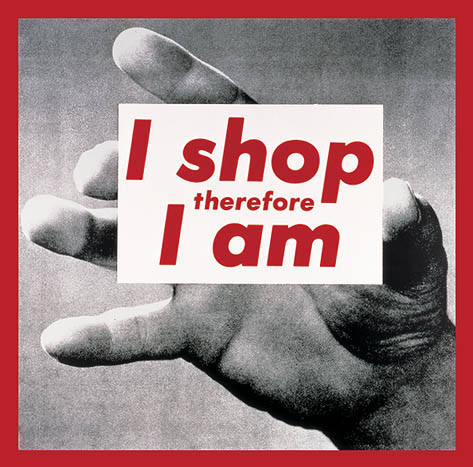
We might also question why critical images of consumerism are so often gendered

The MA Consumption, Culture & Marketing wants to understand life in these conditions. We pose the questions of what politics, meanings and new ways of being emerge. We ask these questions, not on behalf of industry, but on behalf of ourselves as subjects of a consumer society. We ask; is this a good life? What are the horizons of possibility that such a life holds? In whose interest does this orientation serve and what forms of collateral risk occur?

We explore, probe and evaluate the role of marketing as a system of ideological practice. We take marketing seriously as a cultural and economic force but our intention is not to train people in how to do marketing or how to be a marketing manager, but rather how to understand what marketing is and how to evaluate the politics and ethics of a life lived under conditions of near total marketing.

Who Should Study This Programme?

We are all thought of and addressed as consumers and therefore this is a programme which is of interest to everybody. However our preferred applicants are those who want to think intellectually about the world, who enjoy being challenged by knowledge and want to spend many hours reading and thinking seriously about difficult theory and who then want to experiment and investigate their insights by conducting new research. We believe that this programme will be especially of interest to graduates who are curious about business practice but are not interested in taking a business school degree. This programme allows you to understand the application and practices of business but to do so in a way that is entirely intellectually stimulating and in accordance with the university commitment to the pursuit of knowledge for knowledge sake.

Transferable Skills

Whilst we do not emphasise skills-orientated education there is no doubting that the level of critical analysis that we promote leads to deeper understandings of how marketing and capitalism operate that would hold relevance both inside and outside marketing and general commercial practice. Ultimately the skills that we seek to cultivate and encourage relate to how we can understand the world critically, how to engage with complex theory, how to work with teams, how to generate intellectually rich and defendible arguments, how to generate and analyse data and how to think conceptually about the everyday world that surrounds us. These skills can be applied in a range of professions including policy development, publishing, academia and, of course, marketing and commercial management.

Information on our entry requirements and application process can be found here.


Course Fees

Please visit the Fees and funding pages for the latest information about tuition fees and the different sources of funding which may be available to you.

Speical Programme Scholarships 

We hate and regret that our fees are so expensive. To support students enrolling on this new programme within the Faculty of Management and Economics, the Royal Holloway and Bedford New Trust will be funding three “Masters Scholarships”, each worth £3,000 on a competitive basis. Any applicant to this programme who has accepted a conditional or unconditional offer of a place by 3rd May 2013 will be automatically entered into the competition.

Each award has a value of £3,000 which may be received as either quarterly maintenance payments, or as a credit against the programme tuition fee. The award is made for one academic year only.

A panel comprising members of the programme teaching team will meet to assess applications, and identify the three candidates who best “demonstrate excellent potential and/or academic achievement” on the basis of the information supplied in your Royal Holloway application. In order to permit current undergraduates – both internal and external – to provide evidence of achievement during the 2012/13 academic year, the final allocation of awards will be made in week commencing 1st July 2013. Shortlisted candidates may be contacted in advance of this date to request the provision of examination transcripts as they become available. Successful candidates will be informed during the week commencing 8th July 2013. The decision of the judging panel is final.


Tuesday, 5 March 2013

Review of Psychoanalytic Accounts of Consuming Desire: Hearts of Darkness by John Desmond

Psychoanalytic Accounts of Consuming Desire: Hearts of Darkness
John Desmond


Contemplating next-door neighbours, Desmond ponders ‘What unspeakable fantasies are harboured beneath his or her benign countenance that dare not speak their name in the Journal of Consumer Research?’ This is the challenge that Desmond sets for himself: to pull our understandings of consumer behaviour into conversation with over a century of rich psychoanalytic theory and gain insights into consumers’ unconscious hearts of darkness. Readings are thus presented into unconscious imperatives and Oedipal complexes observable to the trained eye and to be found in tobacco adverts, debates surrounding ecology, fears of the so-called sexualisaton of children and the rise of what Desmond argues to be new forms of hysteria like bulimia. Hearts of Darkness is a timely addition to marketing’s burgeoning interest in psychoanalysis and stands alongside a nascent body of work that demonstrates renewed interest in motivational research and psychoanalytic theories and practices (see, for example, Schwarkopf & Gries, 2009; Tadajewski, 2006). Given that consumers are often understood to be irrational and narcissistic, that consumerism invests emotional energy into objects, that advertising tends to operate in the symbolic and sexualised realm and that brands offer identities for introjection, it is puzzling just how little interest consumer researchers have demonstrated into psychoanalytic theory. For those seeking to engage first time round with such a strange body of theory, Hearts of Darkness provides an accessible and invaluable point of entry that adds significantly to the few existing consumption analyses of psychoanalysis. 

That psychoanalysis should be remote to studies of consumption and marketing is itself a curious phenomenon. As Desmond notes, whilst Freud’s 150th anniversary in 2006 was marked by many subject areas, marketing seemed disinterested in assessing his contribution. Tadajewski’s (2006) history of the decline of motivational research (a particular form of market research that stemmed from psychoanalysis and was primarily associated with the work of Ernest Dichter) in marketing is telling in suggesting that external pressures stemming from the American Cold War zeitgeist may have rendered psychoanalysis incommensurable with prejudiced ideals of scientific business scholarship. In such a climate where White Anglo Saxon Protestant pragmatism prevailed, there was strangeness in considering the controversy of the unconscious mind and its charismatic commissioners. Amid such context, psychoanalysis throws us into a domain in which we must explore mental structures and tendencies that do not exist for common sense and are typically articulated as an outcome of intense therapeutic discourse. As Tadajewski (2006) notes, the fabric of motivational research did not quite disappear but rather, appropriately, became sublimated into subject areas like interpretive consumer research and consumer culture theory. Whilst consumer research only rarely explicitly refers to Freudian theory (for instance in the work of Morris Holbrook), basic psychoanalytic theory nonetheless remains paradoxically familiar and foreign to the subject area, a truly uncanny mode of analysis. Therefore, [with a nod to Atkinson & Houseley’s (2003) study of interactionism] we might say that we were never psychoanalytic but also that we were always psychoanalytic. Either way, it is high time that psychoanalysis was given its due and taken seriously within the theoretical canon and subjected to proper readings. 


John Desmond speaking at Royal Holloway

And so John Desmond presents Hearts of Darkness. Readers are plunged from the offset into Freud’s Interpretation of Dreams and may well quickly identify with the dreaming Freud as he perplexedly peers down the throat of Irma and beckons us to regard distorted dreams and fantasies as rabbit-holes into our unconscious mind. The discussion of how Freud understood dreams leads Desmond to analyse consumer research and popular ideas of subliminal advertising and general conceptions of the unconscious in marketing. Desmond notes how a recent article in the Journal of Consumer Research by McFerran et al (2010) found dieters and non-dieters behaving differently when attended by a thin, rather than obese, server and concludes that such scholarship presents interesting parallels with psychoanalytic presumptions of a motivated and goal-driven unconscious. This pattern sets the structure of the book: each chapter presents a deep engagement with specific seminal psychoanalytic theory which is then broadly reflected upon with reference to wider social theory, specific consumer research as well as general societal discussions. A range of subjects are thus presented including sexuality, self-control, hysteria, mimesis, lack, desire, death and narcissism.

The breadth and scope of topics raised is impressive and many theoretical propositions are probed at depth, most notably the theory of Freud, Lacan and Girard. Desmond also skilfully synopsises and contrasts theorists who considered psychoanalytic insights with reference to wider issues of social enquiry: scholars like Elias, Fromm, Lasch and Marcuse. To be sure, this is a text bursting with theoretical overviews and insight - a lifetime of reading and reflection - and Desmond has done an invaluable job in unpacking and representing so much complex theory in such a palatable and personable way. Naturally with so much theory presented, so much is necessarily excluded or scantily addressed and some readers might note with disappointment the absence of, or limited engagement with, major theorists like Klein, Zizek or Jung.

Indeed discussions that relate psychoanalytic insight to consumer behaviour prove no easy task and throughout a sense prevails that Desmond struggles to find relevant studies. As Frosh (2010) notes, psychoanalysis is first and foremost a therapeutic practice and conceiving the applications and implications as psychoanalysis moves outside the clinic can be difficult. The gulf between psychoanalytic insight and consumer research methodology often becomes evident - for example, questions of the power of images to unwittingly seduce consumers are corresponded with surely facile studies in which respondents are asked to express their opinion of the portrayal of advertising images. In a subject area that can be discerned between, on the one hand, approaches that frame consumers as active, rational processors of information whose attitudes can be measured by Likert scales that are expected to directly reflect consumer behaviour and, on the other hand, agentic consumers whose identity projects encounter and deconstruct market ideologies, the idea of an active unstable unconscious that structures and determines behaviour is positively disruptive, if not subversive. At once such an idea recalls earlier marketing scandals involving Vicary’s controversial studies into movie popcorn sales and Packard’s Hidden Persuaders - the best-selling investigative book that accused marketers of subtle manipulation of the unconscious. These scandals, one suspects, remain potent within the subject and may leave scholars cautious and reluctant to broach explicit questions relating to affecting the unconscious. Yet Desmond, disappointingly, has little to say about the methodological implications of psychoanalysis either in terms of the technical challenges of moving the theory outside the clinic and into the supermarket, or the ethical and political consequences of so doing. Perhaps the question should be asked, are the ethical implications at stake so stark that such scholarship might best be avoided altogether?

Where discussions turn to politics, it is mostly with reference to such counter-cultural concerns as, for example, Marcuse’s famous ‘policeman inside one’s one head’ whilst Girardian theory relating to the killing of the scapegoat as a means of reliving antagonism suggests a pessimistic, if not reactionary, rendering of human nature and political possibility. Though such a notional conservatism is perhaps not unsympathetic to Freud’s own fears of unbridled masses as depicted in Civilisation and its Discontents, it nonetheless marks Desmond’s disengagement from radical psychoanalytic political analyses of the sort found in the work of scholars like Slavoj Zizek. Similarly one might be forgiven for imagining that Freud was presenting a theory of heteronormativity for the patriarchy and whilst statements relating to ‘normality’ and ‘perversion’ are often contextualised, just how scholars like Butler and Segal have used psychoanalysis as arsenal for feminist and queer interventions are generally omitted or under-stated. Again, however, in a book that offers so much, it seems harsh to overly reflect on what is missing.

But if there is a disappointing sense of lack in Hearts of Darkness it is because Desmond seems to shy away from presenting a psychoanalytic theory of consumer behaviour itself. Fence sitting ensues – for example, Desmond synopsises the fascinating public exchange between Packard and Dichter but concludes the section without taking a side, just as he abruptly terminates the book without an overall conclusion. Rather the task that Desmond sets for himself is a more humble one of introducing readers to complex theory and thinking through their parallels in consumption. This is a worthwhile goal for Desmond to set for himself and it is one in which the book certainly satisfies. As mentioned, given the widespread neglect of over a century of psychoanalytic theory by consumer research, it is hardly realistic or fair to expect Desmond to pull a theory of consumer behaviour and psychoanalysis together in one swoop. In fact he would have been mad to try. What his book does do is present a generous and thought-provoking synopsis of a huge body of psychoanalytic theory and begin the process of thinking through its relevance for consumer behaviour. As such this is essential reading for those interested in both psychoanalysis and consumer behaviour and the book is certainly to be recommended. The next step, it seems to me, is to build a theory of consumption and psychoanalysis and to think through the methodological, ethical and political consequences. If this is indeed held to be the challenge, then there is no doubt that despite the inevitable criticisms, Desmond’s book provides an entirely worthwhile and important stepping stone towards that aim. It is a book to be read carefully and enjoyed and like all good texts, leaves us asking for more.


Review is to be published in the International Journal of Advertising


References
Atkinson, P. & Housely, W.  (2003)  Interactionism. London: Sage
Frosh, S. (2010) Psychoanalysis Outside the Clinic. London:  Palgrave Macmillan
McFerran, B., Dahl, D., Fitzsimons, G.  &  Morales, A. (2010). ‘I’ll have what she’s having: the social influence of obese consumers on the food choices of others’, Journal of Consumer Research, 36(6):915-929.
Schwarzkopf, S. & Gries, R. (2009)  Ernest Dichter and Motivation Research: New Perspectives on the Making of Post-War Consumer Culture. London: Palgrave Macmillian
Tadajewski, M. (2006)  ‘Remembering motivation research: towards an alternative genealogy of consumer research’, Marketing Theory 6(4):429-466.

Friday, 1 March 2013

Review of Sounds of Capitalism by Timothy Taylor


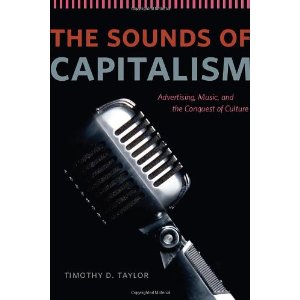
Review of The Sounds of Capitalism: Advertising, Music and the Conquest of Culture by Timothy D. Taylor. Published by University of Chicago Press. 


Sounds of Capitalism presents an impressive history of a near century of use of music in advertising in the United States of America. Beginning with early radio days when advertisers had to innovate how music could become commercially useful, Taylor brings us to contemporary practices of licensing existing music for big production advertisements. Ultimately Taylor argues that not only has music remained central to advertising but more over, music in advertising plays a fundamental ideological role in shaping consumption patterns. Taylor’s work engages directly with Thomas Frank’s influential Conquest of Cool and argues that such is the institutional overlap between music and advertising that we might be better served by understanding advertising as having conquered culture itself. In such a condition of correlativity, Taylor argues that there is no longer meaningful difference between popular culture music and advertising music and that this collapse renders distinctions between art and commerce moot.


Frank’s Conquest of Cool, published in 1998, sought to counter popular understandings of advertising as a cultural practice that appropriates and co-opts counter-culture, re-directing it towards its own preferred logic. By examining the practices and narratives of Madison Avenue advertising agencies during the 1960s, the very period now depicted in Mad Men, Frank demonstrated a greater institutional co-determination between popular culture and advertising. Many advertising practitioners were actually self-identifying participants in the counter-culture and sought to incorporate, rather than appropriate, the vim and verve of youth culture. Hence a sort of hip consumer culture follows with highly influential advertisers like Bill Bernbach ingeniously inscribing insurrectionist vitality into campaigns, redefining the Volkswagon Beetle from the Nazi car to the hippy car along the way. From this point on, advertising could be regarded as in the business of the conquest of cool. This argument has inspired a host of follow-up influential studies such as Holt’s How Brands Become Iconcs and Heath & Potter’s popular Rebel Sell. Taylor addresses Frank’s argument and argues that not only has the ability of popular music to signify cool and hence consumer lifestyle been conquered, but such is the degree of institutional fluidity that advertising has come to saturate and drive popular musical production. In other words, music’s significability is conquered but so too has the content of popular musical production.

One of four jingles Linda November had to sing one day

In this regard Taylor’s text is a study of the ideological mechanisms through which capitalism props up and reproduces itself. This is interesting for subject areas like Macromarketing and Consumer Culture Theory which arguably reify capitalism by systematically preferring neutral terms like ‘markets’. Taylor reminds us that the very idea of consumers and a culture predicated upon consumption is something that had to be imagined and brought into being. Hence the consumerist propaganda of advertising figures such as AJ Thompson (previously analysed by Schwarkopf) is regularly brought to bear as the ideological purpose behind the advertisements is revealed. Interestingly Taylor has little interest in knowing the actuality of how music and advertisement intertwine but instead prefers to observe the cultural changes as described in the many interviews he conducted with advertising legends and the quotations that he pulls from industry magazines. The point for Taylor is not to know what happened but rather to interpret the ideological representations of what happened as depicted by the most active agents.

Barry Manilow, blurring art and commerce, presents his 'jungle of jingles'

Nonetheless for those who are interested in the history of music and advertising, a fascinating subject in itself, this is a book that does not disappoint. For example we learn in colourful detail about early radio sponsored programmes that presented classical recitals in the hope that this would generate goodwill from prospective buyers. As the form changes, we learn of successful jingle singers like Linda November who sang the iconic Meow Meow Meow Meow Mix jingle, as well as three other jingles in the same day! We learn of such characters as the J’s With Jamie; wealthy harmonists beloved by agencies because of their ability to sing with perfect diction. We also learn how many well known musicians worked in the production of ads, like Barry Manilow who worked for years as a jingle writer (and who used to sing a medley of his jingles to huge applause during concerts) whilst Herbie Hancock, Carly Simon, Hoagy Carmichael and many more besides also worked in the profession. Taylor demonstrates the shift in practices which sees musicians working as hired studio hands and jingle composers to Sting freely licensing his song Dessert Rose and appearing in an ad for Jaguar. Sting solicited such exposure partly because he had correctly anticipated that this would boost the sales of his album but also, more interestingly, because he realised that the aesthetic of the song’s video was already commensurable with an advertisement. Such transitions encapsulate Taylor’s arguments regarding the conquest of culture.

Sting's Desert Rose in a Jaguar ad

Taylor develops a derivative theory of Bourdieu’s so-called New Petit Bourgeoisie who were ambivalent about legitimised forms of culture and preferred avant-garde. Accordingly Taylor argues that post-Baby Boomer advertisers are ambivalent about consumption and advertising and claim legitimacy by redeeming advertising through producing more culturally worthy content. It is precisely through navigating this ambivalence, Taylor argues, that the dialectical fuel necessary for a consumer culture is ignited. In this way we can see the important ideological function of the constant institutional interchange between music production and advertising. Arguably at least more than the germination of such an argument was already present within Frank’s seminal text and the extent to which it is true to say that Taylor actually extends Frank's Conquest of Cool argument is perhaps less compelling than presented. Like Frank, Taylor’s history is shamelessly US-centric and hence totally ignored are seminal advertising campaigns and innovations from other countries, such as UK’s Bartle Bogle Hegarty's Levis campaign in the 1980s. Alas given the paradigmatic nature of such non-reflexive US-centricity, it seems unfair to even mention this as a flaw.

No mention of BBH's iconic Levi's campaign because it wasn't made in USA

For a text that begins by promising an Adornian inspired analysis - albeit with the usual dismissal of Adorno as pathologically elitist - little is said about the content of the music itself and how the ideology is musically incorporated. By reserving the right to theorise popular culture production as determined by advertising as a matter of capitalist ideology but also claiming the right to dismiss Adorno's dialectic of preferred modernist music that might offer a counter-balance as elitist, Taylor both has cake and eats it. Indeed more dialectical thinking might have been well served; by the end of the book a reader might legitimately ask - given how musicians are paid enormous licensing fees for advertisers to add promotional and sometimes aesthetic value to their music - does it not make sense to flip the argument and insist that it is the musicians who have conquered advertising and have succeeded in turning advertising into a medium for their own promotion and enrichment?

In any case Taylor’s book presents an excellent account of the convergence of record label, advertising agency and brand and seriously sets about the task of understanding this as a manifestation of capitalist ideology. As such this is a text that contributes to our understanding of advertising history, the history of popular music as well as our general understanding of how art and culture exist ideologically within the culture industry. Sounds of Capitalism is a welcome addition to the literature and is hereby recommended.