For more information about Royal Holloway, please see this promotional video. To see a promotional video for the MA Consumption, Markets & Culture see here. To see a promotional video for the Royal Holloway School of Management, click here.

For more information about the Royal Holloway MA Marketing and MA Consumption, Culture & Marketing and the application process see here.

To get an understanding of the unique values that underly the MA Marketing and MA Consumption, Culture & Marketing programme please read these blog posts: Value of Scholarly Values, Importance of Reading and Morris Holbrook and Business Interest in Education.

Friday, 31 August 2012

Where Public meets Private: the Question of Branding Universities

Universities, we are told, are now brands and strategic brand management is generally understood as the subject which trains people to manage brands. However it seems to me that there is a deeper question that needs to be asked before proceeding to the question of how to manage the university brand. It is a hermeneutical question that concerns why, at this time, does the question of branding emerge and amidst which broader issues should we understand the phenomenon? To be sure, there is a recent history of public and semi-state organisations thinking of themselves as brands and doing so as part of a wider reconfiguration of public institutions relating to corporate behaviour, privitisation and neo-liberalism. According to this line of analysis, to accept the organisation as a brand is already to have accepted the notion that we are a business, that we are service providers, that we produce experiences for our customers and that our students are those customers. Is it within this scope that we discuss our university and our work within a university, as faculty and students alike, as bounded by the logic of the brand and a logic of privitisation? Is there a connection between this discussion and the imperatives found in the government's recent Browne Report? Is re-branding something that should be resisted? Is there an argument to be made that says we should stop thinking in terms of brands and re-commit ourselves to a public conception of the university? Is such a viewpoint inherently anachronistic?


Rather than a logic of differentiation, public bodies often
 develop brands that look extremely similar to other brands.


This is all to say that there is a politics of branding or, if you prefer, a post-politics in which all forms of activity are unquestionably and unreflexively altered to match a corporate agenda. Is there an inevitability for universities to think of themselves as a brand, and does this converge with other supposed inevitabilities: that there should be individualised student tuition fees, that research should have corporate value, and so on? Meanwhile, the Vice Principle at Royal Holloway, Rosemary Deem, has been telling us through her research on the subject that there has been a global trend towards what she terms ‘leaderism’; this generally refers to the corporate strategies that universities pursue, which more often than not are fundamentally incoherent and not subject to critique. Again should we resist branding ourselves?

An excellent book that charts the history of public and semi-state organisations reconfigurating themselves as brands is The Rise of Brands by Liz Moor. Moor looks at organisations who fundamentally are not corporations, but nevertheless accept a corporate style of management as part of a neo-liberal process, a strategy of branding deployed as a technology or as a means for both management and government to facilitate this. This often entails a form of governmentality – meaning that all functions in the organisation now have to justify themselves according to a new means of disciplining, that all acts have to cohere around the principle of the organisation as a coherent brand and that this principle is already front-loaded with assumptions about working in a competitive environment, about clients and customers and so on. Hence we have city councils, hospitals, and universities re-defining themselves as brands. It is interesting to note that, rather than allowing organisations to distinguish each other from their competitors, so called ‘brands’ actually end up looking just like each other. In other words, public institutions undergoing privitisation internalise a need to demonstrate that they can achieve a certain level of 'professionalism' and 'best practice' and one technology for achieving this is to cohere the organisation around a brand identity immediately recognisable as adhering to conventional standards of sector professionalism. From a marketing perspective such a tendency towards uniform representations and homogeneous organisation offends against the subject's commitment to innovation and differentiation and therefore, arguably the process of branding that we witness departs from marketing logic, in fact is best understood as an instance of anti-marketing. And as demonstrated across various semi-state and public sectors, the logic of ‘leaderism’ often coincides with the appointment of chief-executive officer type leaders who command enormous salaries and who are concerned with maintaining these brand values, irrespective of how incoherent they may be.

More branding groupthink

Again, to my mind the critical issue is the relationship between brand logic and the sort of neo-liberal logic encapsulated in government policy and beyond. Do such forms of branding serve a neo-liberal agenda? If it does, we might ask is this something that we should oppose in defence of a more public minded ethos of the university, or should we embrace it either as a coping strategy in unfriendly times during which we should think of our own survival, or indeed should this be something that we should embrace as it arrives with all sorts of new opportunities, a golden moment for universities to assert their autonomy?

Up to now, I have been speaking about branding in negative terms. But it seems to me that there are also all sorts of positive opportunities that can be grasped from such discussions.

If we think of the brand as the values and meanings that are produced in the organisation and created with customers, that in the service sector market meanings and systems are co-produced with, rather than for, customers, then as lecturers we might ask what sort of university are we co-producing with our students? If so, can we insist on having a critical research identity when this contradicts the reality that we see produced in the class room? Namely, a dichotomy that emerges based on conflicting expectations of what purpose a university serves: a common sense grounded vocational approach to business problem-solving or a critical-analytic approach that asks why such problems arises in the first place.

A brand is a way of thinking about an overall organisation, and is therefore much greater than any logo or headed paper or set of staff webpages. If there is agreement that there should be a brand, then for me the critical questions become: what sort of organisation are we, what sort of organisation do we want to be, who gets to constitute and then address this 'we' that is being operationalised, what are the common spaces through which consensus can emerge and critical reflexivity be expressed and respected, does the requirement for a mutual identification with brand values offend against the very spirit of heterogeneity necessary for the intellectual survival of the university during hostile times, and can we represent and communicate values in a way that is distinctive, truthful, and attractive to prospective students and colleagues, and that can help us maintain a commitment towards developing intellect?

Wednesday, 8 August 2012

The London 2012 Olympics: Blustering Jingoism?


80's pop star Morrissey has earned national media coverage this week for his view that the London 2012 Olympics media coverage reminds him in it's tone of the nationalistic propaganda of 1930's Nazi Germany http://news.sky.com/story/969426/morrissey-olympic-spirit-like-nazi-germany

England, he says, is "foul with patriotism". Morrissey, also a vitriolic anti-royalist, is well-known to be a professional curmudgeon. His talent for contrariness keeps him in the public eye, and a lot of people still buy tickets to hear him recycle his old hits. Nonetheless, he is probably expressing views that are held by many others, but can gain no traction amidst the waves of Olympic self-congratulation currently swamping UK media.

On this point, Morrissey and I diverge. Born in the same year as me, the lachrymose lyricist's lilting laments have never been far from my ear. His unique brand of misery is wrist-slashingly compelling, although frankly if he'd never met ace guitarist Johnny Marr I doubt that Morrissey's moans would have reached much of an audience beyond his bedroom.

I am biased, I admit. A sports nut all my life, I love it, and the media coverage now is an armchair sport's fan's dream. In my childhood sports media coverage was truly rubbish, with the exception of the rugby internationals and Bill McLaren's great commentaries. I had a few hours on a Saturday afternoon to listen to TV announcer Frank Bough (born in my home town, Frank knew how to party) as he read out football scores from a mechanical typewriter. Yes, this was TV before Sky Sports. Then I had to wait 24 hours for print newspapers to be delivered to our house find out what had actually happened.

Today, I'm in HD, 24/7, real time, wifi, armchair sportsfan heaven. The main tone I get from the peerless media coverage of the Olympics is not so much jingoism as bemused astonishment. We all really thought we were going to mess it up. Not only is everything going rather well on the organisational side, we're actually winning some medals too. This is the most GB has had to celebrate since England won the world cup in 1966. Why not have fun with it? To be sure, the Olympics is a platform for nationalistic ideology, and some of the competitors are pretty ruthless, even cheats. But it's a vehicle for other ideologies too, not least race and gender equality, friendship and meritocracy.


The GB team is a refreshing mix of ethnicities, colours and classes. I don't buy into claims that it is 'elitist', and I'm not sure what that means. One of GB's most eminent medal winners, Bradley Wiggins, grew up in a council flat in London after his dad left when Bradley was two years old. The GB team were not cherry-picked for stardom when they were 6. That just isn't how it works. They're dedicated club athletes who put more into the sport than they take out of it. Most are not wealthy by any means. To be sure, some sports have a disproportionate representation from elite fee-charging schools, notably rowing. But the sport itself isn't exclusive. People's choices are framed by their environment. If you went to an inner city comprehensive rowing isn't the first thing on your sports & social agenda. Without doubt, the UK's investment in its school sports infrastructure needs to be much better. But cultural and class norms are more powerful than social or economic exclusivity in making sports participation uneven in the UK.

Meanwhile, I'm enoying it all in spite of Morrissey. Go TeamGB.

There's more from me on this here....http://www.chris-hackley.com/search?updated-min=2012-01-01T00:00:00-08:00&updated-max=2013-01-01T00:00:00-08:00&max-results=9      


Monday, 6 August 2012

Un-branded – the London 2012 Olympic Park experience


The main London 2012 Stratford site, a vast reclaimed tract of east London, greets the visitor with bright, energetic colours that includes vibrant recycled rubberised flooring, nearly fluorescent signage and the gaudy juxtaposition clashing colours, all strikingly fresh.  The river bank planting accentuates bright and strong use of colour, with prairie planting of yellows and blues, of bright peach red hot pokers set against striking purple blue agapanthus globes.  The bright red of the roller coaster like feature building, the imposing relief Olympic circles on the aquatics centre, its roofline inspired by the underbelly of a whale.  

Acres of bill board space was either foregone or instead covered with one of the vibrant rainbow range of colours (with bright pink a signature colour, used prominently in signage) and the 2012 Headline font, described as distinct and quickly recognisable. (Observer, 2012) This feeling of unclutteredness contributed to a strong sense of place, neither city nor country, supported by happy, smiling and fun giving uniformed volunteers. 

Even the BBC broadcasting centre in the park, which provided in-the-thick-of-it backdrops for smiling medallist interviews and sliver fox anchor feel-good interviews, was surprisingly anonymous.  Constructed, Lego like, using blue shipping containers with glazed voids and a roof terrace, highlighting strong re-cycling credentials.  Missing also were the blitz branded interview back boards, made popular by football post match interviews, perhaps forcing the unusual re-introduction of the hand held lolly pop microphone prominently sporting the BBC brand alongside the Olympic rings, all in yellow and the use of the plain yet colourful Olympic venue as the backdrop. 

It was all a bit like wandering around Moscow, just after the communist experiment had been shown to fail, subtle signage, here and there, just enough to help guide you around at the points of ambiguity, but else, nothing.  A blank canvass, nearly. 

Generic labels adorned the various merchandising stands ‘speciality coffee’ where surely Costa, Nero or the ubiquitous green mermaid would be expected ?  There were Innocent branded wheeled carts (Coca Cola owned), but the roving young people wearing back packs emblazoned with the word ‘BEER’ took to holding up a specimen bottle, often Heineken, seemingly required to overcome the lack of information that is usually and usefully conveyed by a logo, symbol or brand name.  A feeling not unlike BBC Childrens TV, sticky tape not Selotape or Scotch, glue stick not Pritstick, double sided sticky tape not Blutack.  Brand identities expunged either taped or painted over. 

Clear and evident: a conscious rejection of one of the generally useful roles brands play.  For me, it created a rather unnatural world, a TV studio or film set that deliberately removes cultural advertising references to transform the audience to a different place. 

The impact of the heavily controlled and minutely planned execution of this leading global event, which saw 10bn viewers for its opening ceremony and a third of the UK population tuned in to see Usain Bolt win the 100m dash, may well go on to help define an Olympic experience supported, but not dominated, by advertising sponsorship.  

Justin O'Brien, MBA Director and Teaching Fellow at Royal Holloway, University of London.

Looking for something marketing-related to read on holiday?

If you are thinking about reading something marketing related during your Summer holiday but want to avoid dense theory or anything too managerial then I recommend Stephen Brown's trilogy of novels in which he parodies Dan Brown. So the series begins with the Da Vinci Code re-written as The Marketing Code, Angels & Demons becomes Agents & Dealers and finally The Lost Symbol becomes The Lost Logo. Last year Stephen Brown addressed the Royal Holloway Marketing Camp with a spectacular and glorious pyrotechnic talk entitled "Sex with Philip Kotler". Here is a review that I wrote for the second installment, Agents & Dealers.


Stephen Brown is leading a revolution in marketing writing. Following from the so-called crisis of representation which saw marketing knowledge presented in the form of poetry, films, dance and music, Brown suggests that the remaining logical step is to present ideas about marketing and consumer behaviour in a truly novel form; the novel itself. Not only will this novelisation of knowledge lead marketing scholars away from an erstwhile destiny of producing unreadable journal articles, but it is also submitted as a welcome alternative to boring textbooks that fail to capture our students' imagination and also, as it is noted that business people tend to buy both business books and murder best sellers when at airport bookshops, an attempt to reduce the volume of hand luggage in business class by synthesising fast-paced thrillers with marketing scholarship. If marketing is a world alive with adventure and not a dull white-coated science, the challenge that Brown sets for himself in Agents & Dealers is to replace the bullet-points with bullets. What follows is part two of his soon-to-be-completed trilogy, all written as parodies of the works of one of the great marketing successes of our age, Dan Brown. Just as the Marketing Code was a parody of the Da Vinci Code, this time round its prequel Angels & Demons is re-worked as Agents & Dealers.

Those familiar with Agents & Dealers' sequel the Marketing Code which raised issues of marketing theory in the form of bizarre Dan Brown rituals and conspiracies, will be pleased to read the return of the larger-than-life uber-Scot Professor Pitcairn Brodie and his anti- man-of-action hero PhD student, Simon Magill not to mention the Jewish-Protestant freedom-fighting cynical profiteer that is King Billy. However, added to Brown's burgeoning cast are the unlikely femme fatale, Abby Maguire, whose life as a retail undergrad on work-placement is hurled towards the dangerous underworld along with her accomplice, the lead singer of the Goth band Love Pump cum high-camp marketing lecturer from the University of Hustler, Dr. Dave "the Rave" Kelley. Together these characters, sparkling with sexual tension, are forced to match their wit against double-agents and double-dealers amidst the distinctly Irish Priory of Ryan and WB Yeats lead conspiracy. We find the protagonists wrestling with the Citroen transformer robot in the streets of Nuremberg, scamming through Edinburgh, caught in a shoot-out in a Belfast monastery, horse-whispering in the Irish midlands of Mullingar and just about finding salvation through sex-toys in an adult shop in Carrickfergus.

For keen Stephen Brown readers, this is the book where the master of marketing slogans achieves what must surely be his apotheosis as he finally and inevitably unleashes his idiosyncratic imagination on naming sex products and promotions ("buy-one-nipple-clamp-get-one-free" and an "auto-erotic extravaganza in no-partner November"). To be sure, this is the book which takes a turn towards the ribald. Beyond references to Rudolph-the-Red-Nosed-Rabbit we also find a rape scene, paedophilia and castration. No doubt about it, this is a textbook with edge.

There is also a great depth to the research for this novel. Hitler's (dubious) Irish connections are mined to create a Nazi conspiracy that threads together Otto Skorzeny with Eamon De Valera and WB Yeats. The attention to detail and commitment to authenticity are nothing short of extraordinary and Stephen Brown actually pens a trio of fake yet carefully-crafted Yeatsian three stanza ballads which, it transpires, are actually a code connected to the streets of Edinburgh. Now that is impressive and that same level of ingenuity (for how else can it be described?) flows through the imaginatively wonderful conspiracy plot throughout these pages. And just like he did in the Marketing Code, Brown succeeds in matching Dan Brown's own propensity for page-turners.

Agents & Dealers smuggles nuggets of marketing theory throughout the pages. Brown's well-versed argument that marketing is not a science but a wonderland of enchantment in which marketers are alchemists and even crazed fanatics is, once again, laid to bare. But as a master code craftsman, the references to marketing are so embedded in the attention consuming narrative that they can be easy to miss. For example, Brown reveals whilst recently writing for the Irish Marketing Review that the discussion between two characters as they decide where they shoplift, is actually a meditation on the problematic process of market classification. This may well result in a sense of less of a takeaway for marketing theory than is found in the Marketing Code but this is surely forgivable given the quality of conspiracy that is conjured.

At a time when critical perspectives seeks to deliver the imaginative and creative away from conventional marketing, Brown is intent on seducing us all back by reminding us that conventional marketing is anything but conventional but is a rich and fertile field for the creative to farm. Agents & Dealers, as part two of Stephen Brown trilogy, would take our imaginative and creative curiosity for understanding marketing to untold places. It is a journey worth taking.

Monday, 9 July 2012

Proofreading for Non-English Speaking Students by Mike Faulkner


As a professional proofreader, some of my work is in the area of assistance for non-English speaking students in their written work. This is mildly controversial, since academic staff are reluctant to put students in a position where the boundary is blurred between the student’s work and someone else's; and I must say I have sympathy with that reluctance. Plagiarism and passing-off are real problems, especially in the internet age. I was asked recently to proofread a series of papers for a Spanish medical student (or students – I never discovered which), where the brief was to check for grammar, punctuation, spelling and content. Content, particularly in the context of a university course, is not the province of a professional proofreader, though it may be the province of an unprofessional one – no doubt somebody got the job!

Mike Faulkner


From the student's point of view, there isn't always a problem because on-campus help is available at many universities, often under the auspices of the International Office, Grad School or Students’ Union. At Edinburgh, for example, the Students' Association operates a Peer Proofreading service where volunteers, who are vetted for aptitude, accept electronic versions of assignments and give them the once-over for spelling and use of English. At Manchester, students are offered one-off academic writing tutorials. If you're lucky enough to be a Chinese student at University of Regina, Saskatchewan, where there are strong historical ties with China, you will get classes in English as a second language, and assistance with written work in all courses and at all levels.

That said, where on-campus help is patchy, limited or unavailable I have sympathy with the non-English speaking student who may get along well enough in conversation, but who finds it hard to make an argument on paper using consistently well-structured, grammatically correct English with just the right shade of meaning – not to mention the unfortunate tutor who, in order to mark fairly, may have to work hard to get at the arguments at all. Take this opening sentence of a paper on Long Tail Marketing (the subject is spurious but the structure of the sentence is from an actual paper):-

'The long tail of marketing has reached unprecedented influence among the world in recent decades more than ever.'

The meaning is clear, but the sentence is grammatically problematic and not very elegant. The student may well go on to make a persuasive argument, but there’s a danger that the limitations of his or her vocabulary will obscure it. As a proofreader, if I were offered this sentence I would want to render the prose more clearly and excise the tautology of the last three words, ending up with something like this:-

'In recent decades, the concept of the “long tail” of marketing has gained unprecedented currency around the world.'

But it's important to know when to stop. Were it not the premise of the whole piece, I might be tempted to check whether the writer meant 'Long Tail Marketing' or the 'long tail of marketing', which has a subtly different meaning. Often the writer will use buzzwords or forms of expression which seem out of place but which turn out to be particular to the discipline in which he or she is training, so what appears to be a wrong construction may be nothing of the sort. Even if it is wrong, it may well be the case that the student should have got it right; my point being that, either way, it’s likely to be outwith the scope of proofreading. (Which brings me to another, similar, point: in the previous sentence I used the word ‘outwith’, which you won’t find in every dictionary – interestingly, it’s in Oxford, but not Chambers – so there’s another case of, ‘if it ain’t bust, don’t fix it’.)

My advice to non-English speaking students who are having difficulty is this: first, check out the assistance available within the university; if that assistance is inadequate or non-existent, or if for some other reason you are unwilling to avail yourself of it (I know from reading – actually, proofreading –  sociology papers that some students are reluctant, even embarrassed, to share what they see as a 'problem' with their peers), then I would say, discuss the options with your tutor and seek help from a professional proofreader only if you are given their blessing.

If you are interested in the specifics of what proofreading involves, there is a brief overview on the Proofreading page of my website at www.thebluecabin.com/proofreading. Please ignore the ‘Light edit’ option which, as I hope I’ve made clear, goes beyond what can properly be offered to university students!

Thursday, 5 July 2012

Advance Readings For MA Marketing

For those students about to commence studies in the Royal Holloway MA Marketing, I strongly urge you to conduct advance reading. This will prepare you for the way that we approach the subject of marketing and also, hopefully, create a common body of knowledge among the students which will facilitate better class discussion. Therefore I recommend the following texts:

1. Critical Marketing by Chris Hackley


This book is the essential reading for the Critical Marketing core module that will be presented by Chris Hackley. The emphasis on critical approaches, not just managerial application, is a distinctive aspect of the Royal Holloway MA Marketing and this book serves as a very helpful introduction that will allow students to orientate themselves around various parts of the programme content. In particular the book emphasises that marketing should be studied and understood with an intellectual robustness and roundedness that one would expect of any humanities or social science field of study.

2. Contemporary Issues in Marketing & Consumer Behaviour by Liz Parsons & Pauline Maclaran


This textbook is used by Pauline Maclaran as essential reading for the Contemporary Issues in Consumer Research core module. The text provides an overview of a diverse range of societal issues raised by marketing activity and contains contributions from a series of scholars. The text looks at the history of marketing thought, ethical consequences of marketing and gender implications among many other topics. In short the book provides a highly eclectic set of commentaries and analyses about the field of marketing and its consequences.

3. The Rise of Brands by Liz Moor


This book provides a wonderful overview about brands and analyses them from a variety of viewpoints and brings a theoretical richness which far exceeds the conventional framing of brands. Brands are reviewed historically and understood as ideological technologies during an era of neo-liberalism.

4. Brands: Meaning and Value in Media Culture by Adam Arvidsson


From years of teaching brands and branding it is clear that the concepts that students find most difficult to comprehend are the very theories that stem from this book. It is indeed a difficult read but bear with it because the analysis of branding that is presented is an excellent exploration into how we can understand value with reference to the vagueness and strangeness of brands as  immaterial social technologies. In an age where brands generate gigantic financial evaluations and can be thought of as the chief asset of organisations, Arvidsson's book works through the mechanics of how value can be understood. Yes, this is a difficult read but if you can get a good grasp of this theory, you will find the course much easier to engage with.


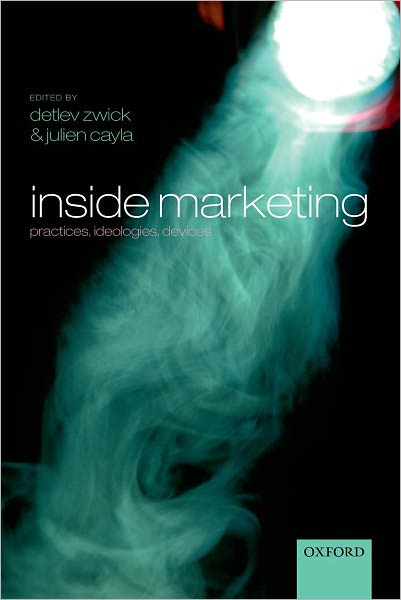
5. Inside Marketing: Practices, Ideologies & Devices by Detlev Zwick & Julien Cayla


While this book is not attached to any particular module and is indeed outrageously expensive (sorry), it provides an excellent series of commentaries that explore how marketing functions and is practiced. You can read my full review of the book here.

(Note - Julien has posted in comments below that the book is available for £20 via the Book Depository)